Saturday, May 7, 2011

ROW Lecture Tour - India Part 5


This is the type of bed on which most sleep, commonly known as a charpoy. Fortunately I was not required to sleep on one without a mattress for more than one night, yet that night was not too sleepless either. Otherwise I was provided with a thin, but quite adequate mattress. Overall much better than  the bed of nails often displayed as commonly used by yogis.


If they could afford to do so, the local people loved to paint their houses in bright colours.


It is a real joy to see the pride these people take if and when they can afford to do do so. Most, of course, cannot afford to do so.


From time to time, amongst the two or three roomed dwellings of the average person, we find some quite large mansions.


No matter whether the house is large or small, it is always open to visitors, and especially some-one from a far country is made welcome even in the most modest of homes.


Whilst in Kerala I had the priviledge and joy of meeting with Dr Sukumar Azhikode, writer, scholar, author,orator, and teacher. These are some of the awards he has received in his lifetime.


Dr Azhikode and myself.


Dr Azhikode's home and him saying his farewells to another friend, the Buddhist monk, Bhanta U Dhammanda  and Dr  Viswambharan


This is a photo on Dr Azhikode's wall of a time when he addressed over 30,000 people so I was informed.


This is the first of a number of vegetarian  and Eco- shops set 
up by Dr Vadakkanchery


This was the investment of appreciation and friendship to myself on the at one of the Life Natural, Nature Cure Hospitals, on the eve of my departure to the UK.


Thank you to all of our friends, Nature Curists, Hygienists, and those who believe, and support, and continue to support the ideals and practice of Nature Cure and Natural Hygiene in India, for inviting me to visit, and share with you the vital truth's of these disciplines. 


Friday, April 29, 2011

ROW Lecture Tour - India Part 4


The local people use honey to sweeten almost everything, including the water they drink. Here are the hives for the bees from which they collect the honey. These hives, as can be seen are less than half the size of those used in the western countries.


This is the small hand operated extractor which is used to extract the honey from the comb. The use of this machine is shared amongst a number of the villagers, as for them not only is this the most cost effective way of doing things given that no one has a great deal of money, it is also the most practical.


In places that cater for both the local culture and the western culture, it is interesting to see the development of toilets which cater for both. For in the past, and of course still is for the majority of the people of India, squat toilets, or just digging a hole in the ground, or in some instances, not even that, was/is the norm. As can be seen this toilet enables both methods to be utilised.


Large retal stores similar to those we see in the West are becoming more and more common in India, although surprising at it may seem, they do not open for business until 11am. On the other hand they do not close till 10pm either. For it is not until later in the day, and night, that the people of India are most active. This security guard has headgear and sash remniscent of the days of the Raj.


Bhante U Dhammanda, a Buddhist monk from Malaysia, was also visiting the area, and somewhat the same places, and meeting with the same people. He has invited me to visit Malaysia next year to speak to their people. If I am to take up all the invitations to speak, I will have very little time for the farm. Each will need to take their turn so it appears.


This is one of the attentive groups that I addressed whilst in Kerala, India. If necessary they would sit for hours to hear something new, and/or different


At these gatherings we were often given bouquets of flowers, amongst other things, as a showing of their gratitude for the lecture. One Westerner commented on how unusual this was for flowers to be offered to to a Westerner as in the Western society they only be offered to a woman. In reality it is a delightful custom, particularly as the people are so poor, and the flowers are virtually free for them to offer as a token of their esteem and does not represent a hardship either on the giver or the recipient.


This is one of the more opulent homes we spent the night in It belonged to a retired teacher of French, and was in a very beautiful setting surrounded by mostly cocoanut palms, bananas and other tropical plants


On this property was to be found a very rare type of cocoanut tree the name of which I unfortunately did not record at the time.


This is a part of the old original dwelling which is now occupied by the oxen


The beautifully Hand carved doors and interior motifs in the home were a delight to see in this day and age where such things are not only a rarity in Western society, are rarely if ever seen.
Lounge Room


Interior staircase
A very homely and delightful place to spend the night, as well as having a most gracious person as a host. It was far superior to spending one's time in the best of hotels I can assure you


Thursday, April 21, 2011

ROW Lecture Tour - India Part 3


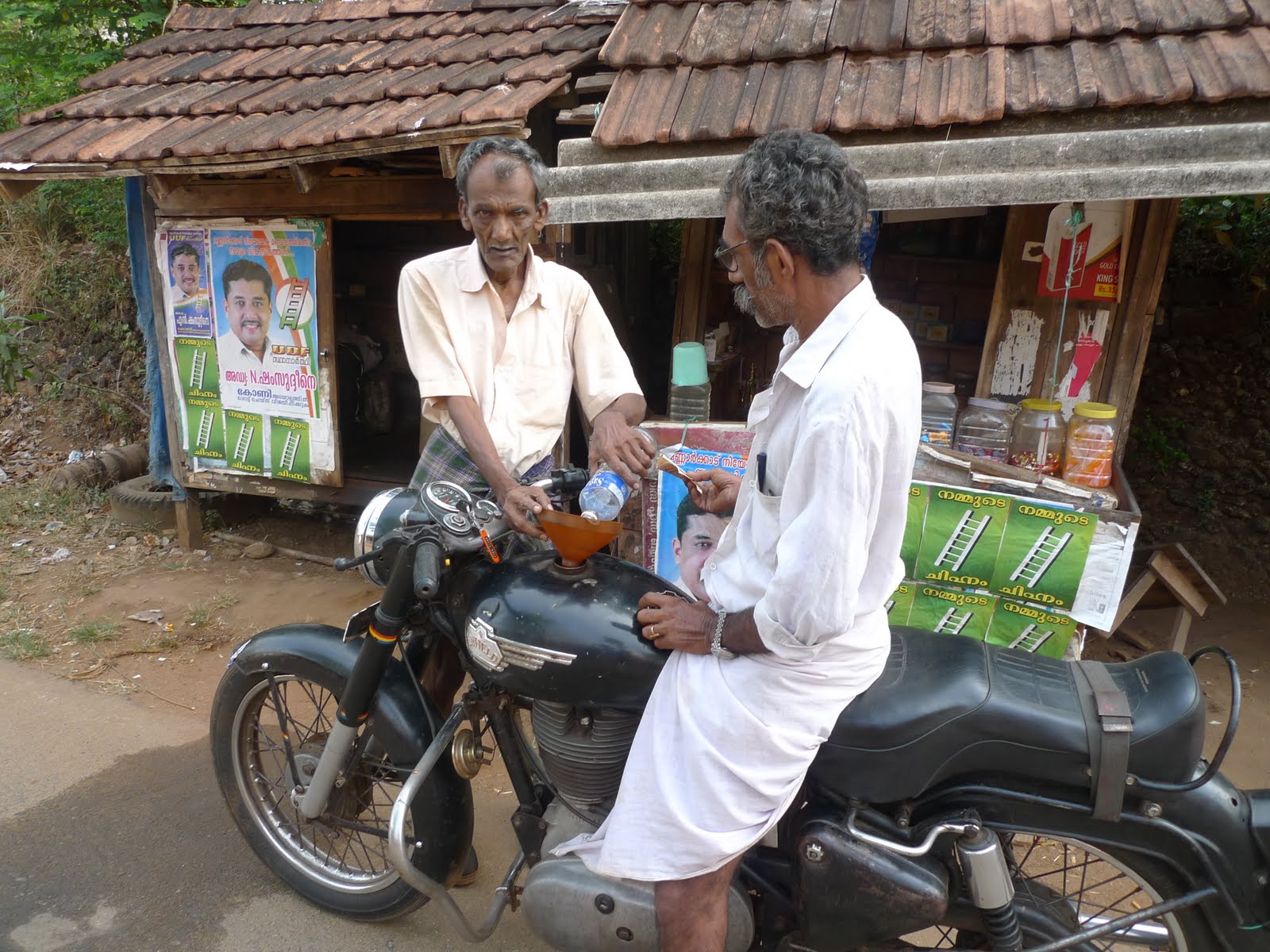
Re-fuelling your bike from the local store where the storekeeper buys it in small amounts of maybe one gallon, and dispenses it a litre at a time - in plastic bottles. No pumps, or warning signs about the hazards of smoking, or remembering to turn of your engine.


Here we are on this self-same bike as we set off for a tour of the village so kindly offered by this local resident. The bike was an Indian produced replica of the English Royal Enfield, which is known there as just Enfield, having dropped the name Royal. A very sturdy and reliable bike it is too. I loved riding on it and the tour of the village.


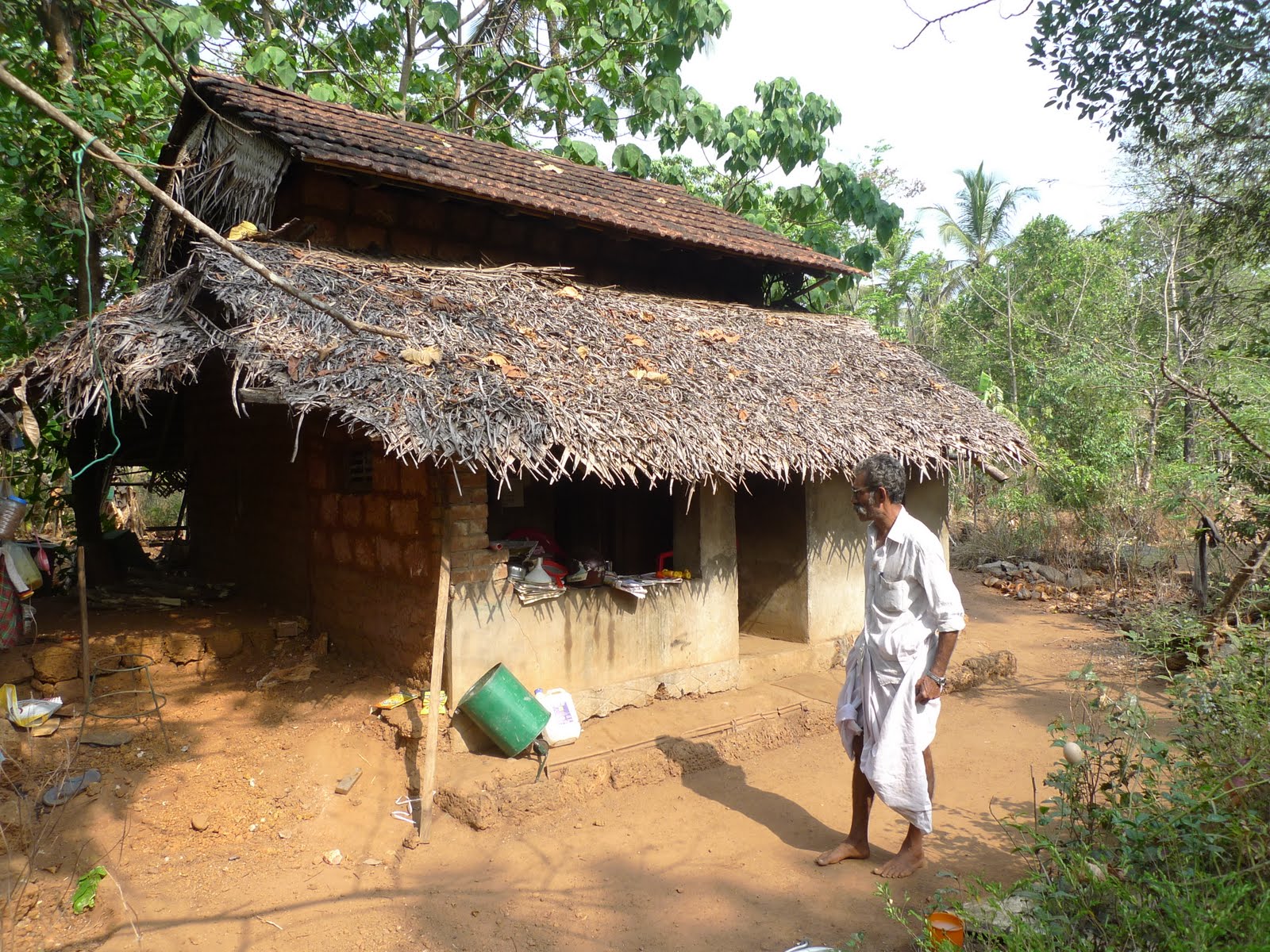
On the tour we visited his home a traditional thatched roof, earthen floored dwelling.


We spent some time chatting with his wife and partaking the usual refreshment which is traditionally offered. In this instance is was water sweetened with honey which has been collected from their own hives.


As we toured round, we passed numerous small rubber tree plantations which are popular with the villagers providing a source of income as a cash crop, as rubber is still quite in demand.


The young trees take from 7 to 8 years before they come into production.


This is the river in which I swam almost each day whilst in Kerala. I enquired about crocodiles and was told that yes, they had had crocodiles many years ago, but no longer did so. I am not sure how long ago this was. They also informed me that monkeys were not a problem for them, u elephants were.


This is one of the many pumps the people have for irrigating their land and the crops they are growing. I was informed by this landholder that they were very fortunate in having sufficient water to not have any restrictions placed upon the amount they could pump out of the river.


Wednesday, April 20, 2011

ROW Lecture Tour - India Part 2.


This was my home for most of the time whilst I was in Kerala. A most delightful setting amongst the fruit trees, cocoanuts, bananas, jak fruit, and many others. Each day I was able to bathe in the river which made me feel very much at home, the river being a short walk through the plantation of cocoanuts and bananas.


And here we have the ubiquitous tuk tuk the local peoples taxi which is to be found almost everywhere in SE Asia. They are great for getting around in and quite reasonable with their fares. Although of course you need to learn to bargain, for this is a part of the Asian culture. And to always be sure to do so before you set out. Today some have a meter, which of course precludes all discussion. Even here though caution is required for in many instances the meter just does not work. One thing they can be good for too, is a great adrenalin rush, for driving in India is not for the unwary.


This was my contact with the world, the local internet cafe. Whilst in India I had the opportunity to use many such places, and this one was my favourite as it was scrupulously clean, something which was a rarity.


This is a view of the street which we visited to buy dates in bulk, with nearly every store, if not all the stores selling them


The dates were packed mostly in cartons, although as can be seen here, they also were available in larger quantities in plastic bags.


Here is the train on which we travelled for 8 to 9 hours to Bangalore. These trains usually consisted of 20 or more carriages and seemed to be always full to overflowing with every seat occupied and people sitting in the corridors. Although all the windows were open and they had lots of interior fans, the air still seemed to hardly circulate and it was quite hot. This did not bother me, it was the long period of sitting. So when I could, I spent many hours standing by the doorways.


All who visit India, so I believe, should avail themselves of the opportunity of travelling on the local trains. They are not essentially clean by our standards, and most certainly not the most comfortable. Yet the experience of the contact with the local people is one, which in my opinion, is well worth having. I most certainly would not have "missed it for quids", as the saying goes.


You need to rise very early in the morning if you wish to beat the traffic. This is a normal street scene at almost any hour of the day, seven days a week.


Another of the sights still relatively common on the streets in India is the provision of secretarial services on the sidewalk.


Walking the streets, one would be hard put to think that there was refuse collection. Yet here is a refuse truck to refute such thoughts.

Yet the piles of refuse continue to be found on the streets, never seeming to be coming less.


Monday, April 18, 2011

ROW Lecture Tour - India

This years ROW Lecture Tour commenced in India where I had the fortune to stay with and be hosted by Dr K Viswambharan i Kerala, south-west India

During my time there we also visited with Dr Jacob Vadakkanchery .


Dr Vadakkanchery is pictured here with his first child. He is in the process of opening Nature Cure Hospitals in many parts of India and has been able to negotiate with the government to utilise the old disused medical hospitals which have become available as new one's are being built. 


This is one of the Nature Cure Hospitals and its entrance which is operated by Dr Vadakkanchery.


Sunday, March 13, 2011

Max's Story


Hi WEEK 1 CLOSHEY RV HEALTH FARM,,,,,,,, Well, well, well and that is how is feel ,,,,Iv lost 5kgs first week ,, full of energy ,, and feeling so well,, Walking 10 km's at a stretch everyday and finish that of by swimming in the Closhey Rv ,,,My blood pressure is back to normal ( no medication ) 80 over 120 ,, perfect,,, All the swelling has gone out of my left ankle , not to mention the gout pain,,, We eat only raw food here ,, nothing cooked ,, it is so yummy,, so tasty ,, My sleep has returned to 8 hours a night ,, wot a blessing that is I can tell you,,,The real challenge is to take it up when Im home , but for now ,, Im going for it aand loving it Maxxxxxxx


Saturday, February 12, 2011

Dr's Paid to Make You Mental

.

doctors paid to make you mental

(NaturalNews) The U.K. National Health Service (NHS) has decided to turn its health care system into a giant game where doctors who recruit the most new mental patients win cash prizes. The equivalent of over $243 million is set to be divied out based on which general practitioners (GP) garner the most new business in the mental health field, an effort that is sure to add thousands of new people, including young children, into the category of having mental diseases.


The effort, say authorities, is to help craft a better preventive approach to mental health by catching problems early, and thus saving money in the long term. Sources say NHS currently spends the equivalent of over $16 billion a year treating mental health disorders. So by helping people early, overall costs will subside, so they say.


But the endeavor also has the potential to tag thousands of otherwise healthy people as mentally ill, which will plunge them into various therapies, including drug interventions, for disorders they likely do not even have. Everything from getting angry to excessive emailing is now considered to be a sign of mental illness, and the list of "disorders" continues to grow. Just last year, psychiatrists even tried to say that choosing to eat healthy foods is a mental disorder (http://www.naturalnews.com/029098_o...).


Check out this video at NaturalNews.tv for a simple, clever, and to-the-point look at how the field of psychiatry falsely labels normal people as having mental disorders:

http://www.naturalnews.tv/v.asp?v=7...


And now, U.K. GPs will be able to rake in a whole lot of dough for recruiting new mental health patients into the tangled, fraudulent web of psychiatric medicine and treatments. The contest is a perfect opportunity to recategorize potentially millions of ordinary folks as having made-up diseases so they can begin to undergo things like "cognitive behavioral therapy" (CBT), as well as take extensive drug regimens that mellow out the brain and induce conformity.


Sources for this story include:


http://www.guardian.co.uk/society/2...


Learn more: http://www.naturalnews.com/031239_menta .... z1DXi3jvr9