Friday, April 29, 2011

ROW Lecture Tour - India Part 4


The local people use honey to sweeten almost everything, including the water they drink. Here are the hives for the bees from which they collect the honey. These hives, as can be seen are less than half the size of those used in the western countries.


This is the small hand operated extractor which is used to extract the honey from the comb. The use of this machine is shared amongst a number of the villagers, as for them not only is this the most cost effective way of doing things given that no one has a great deal of money, it is also the most practical.


In places that cater for both the local culture and the western culture, it is interesting to see the development of toilets which cater for both. For in the past, and of course still is for the majority of the people of India, squat toilets, or just digging a hole in the ground, or in some instances, not even that, was/is the norm. As can be seen this toilet enables both methods to be utilised.


Large retal stores similar to those we see in the West are becoming more and more common in India, although surprising at it may seem, they do not open for business until 11am. On the other hand they do not close till 10pm either. For it is not until later in the day, and night, that the people of India are most active. This security guard has headgear and sash remniscent of the days of the Raj.


Bhante U Dhammanda, a Buddhist monk from Malaysia, was also visiting the area, and somewhat the same places, and meeting with the same people. He has invited me to visit Malaysia next year to speak to their people. If I am to take up all the invitations to speak, I will have very little time for the farm. Each will need to take their turn so it appears.


This is one of the attentive groups that I addressed whilst in Kerala, India. If necessary they would sit for hours to hear something new, and/or different


At these gatherings we were often given bouquets of flowers, amongst other things, as a showing of their gratitude for the lecture. One Westerner commented on how unusual this was for flowers to be offered to to a Westerner as in the Western society they only be offered to a woman. In reality it is a delightful custom, particularly as the people are so poor, and the flowers are virtually free for them to offer as a token of their esteem and does not represent a hardship either on the giver or the recipient.


This is one of the more opulent homes we spent the night in It belonged to a retired teacher of French, and was in a very beautiful setting surrounded by mostly cocoanut palms, bananas and other tropical plants


On this property was to be found a very rare type of cocoanut tree the name of which I unfortunately did not record at the time.


This is a part of the old original dwelling which is now occupied by the oxen


The beautifully Hand carved doors and interior motifs in the home were a delight to see in this day and age where such things are not only a rarity in Western society, are rarely if ever seen.
Lounge Room


Interior staircase
A very homely and delightful place to spend the night, as well as having a most gracious person as a host. It was far superior to spending one's time in the best of hotels I can assure you






Thursday, April 21, 2011

ROW Lecture Tour - India Part 3


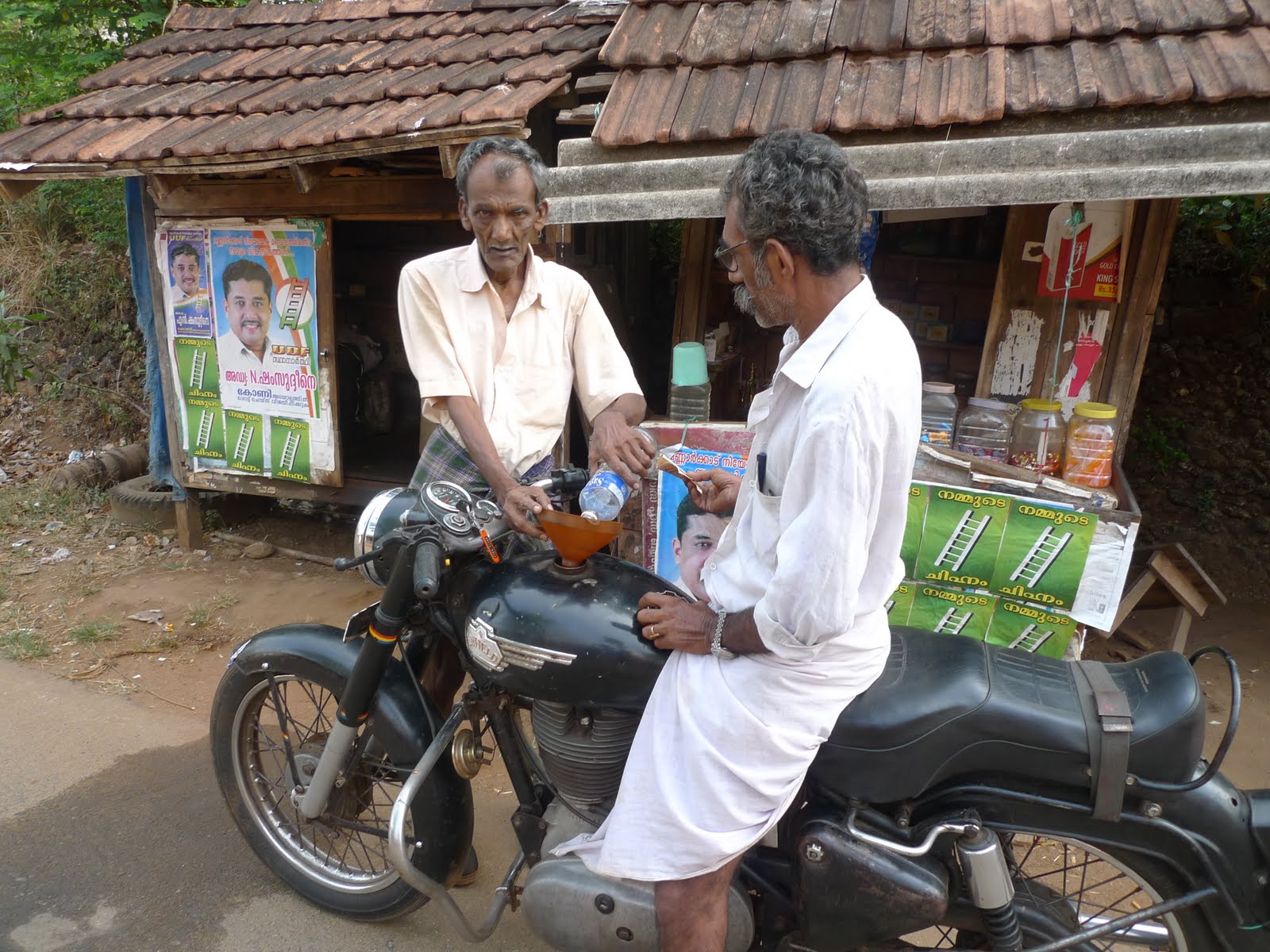
Re-fuelling your bike from the local store where the storekeeper buys it in small amounts of maybe one gallon, and dispenses it a litre at a time - in plastic bottles. No pumps, or warning signs about the hazards of smoking, or remembering to turn of your engine.


Here we are on this self-same bike as we set off for a tour of the village so kindly offered by this local resident. The bike was an Indian produced replica of the English Royal Enfield, which is known there as just Enfield, having dropped the name Royal. A very sturdy and reliable bike it is too. I loved riding on it and the tour of the village.


On the tour we visited his home a traditional thatched roof, earthen floored dwelling.


We spent some time chatting with his wife and partaking the usual refreshment which is traditionally offered. In this instance is was water sweetened with honey which has been collected from their own hives.


As we toured round, we passed numerous small rubber tree plantations which are popular with the villagers providing a source of income as a cash crop, as rubber is still quite in demand.


The young trees take from 7 to 8 years before they come into production.


This is the river in which I swam almost each day whilst in Kerala. I enquired about crocodiles and was told that yes, they had had crocodiles many years ago, but no longer did so. I am not sure how long ago this was. They also informed me that monkeys were not a problem for them, u elephants were.


This is one of the many pumps the people have for irrigating their land and the crops they are growing. I was informed by this landholder that they were very fortunate in having sufficient water to not have any restrictions placed upon the amount they could pump out of the river.


Wednesday, April 20, 2011

ROW Lecture Tour - India Part 2.


This was my home for most of the time whilst I was in Kerala. A most delightful setting amongst the fruit trees, cocoanuts, bananas, jak fruit, and many others. Each day I was able to bathe in the river which made me feel very much at home, the river being a short walk through the plantation of cocoanuts and bananas.


And here we have the ubiquitous tuk tuk the local peoples taxi which is to be found almost everywhere in SE Asia. They are great for getting around in and quite reasonable with their fares. Although of course you need to learn to bargain, for this is a part of the Asian culture. And to always be sure to do so before you set out. Today some have a meter, which of course precludes all discussion. Even here though caution is required for in many instances the meter just does not work. One thing they can be good for too, is a great adrenalin rush, for driving in India is not for the unwary.


This was my contact with the world, the local internet cafe. Whilst in India I had the opportunity to use many such places, and this one was my favourite as it was scrupulously clean, something which was a rarity.


This is a view of the street which we visited to buy dates in bulk, with nearly every store, if not all the stores selling them


The dates were packed mostly in cartons, although as can be seen here, they also were available in larger quantities in plastic bags.


Here is the train on which we travelled for 8 to 9 hours to Bangalore. These trains usually consisted of 20 or more carriages and seemed to be always full to overflowing with every seat occupied and people sitting in the corridors. Although all the windows were open and they had lots of interior fans, the air still seemed to hardly circulate and it was quite hot. This did not bother me, it was the long period of sitting. So when I could, I spent many hours standing by the doorways.


All who visit India, so I believe, should avail themselves of the opportunity of travelling on the local trains. They are not essentially clean by our standards, and most certainly not the most comfortable. Yet the experience of the contact with the local people is one, which in my opinion, is well worth having. I most certainly would not have "missed it for quids", as the saying goes.


You need to rise very early in the morning if you wish to beat the traffic. This is a normal street scene at almost any hour of the day, seven days a week.


Another of the sights still relatively common on the streets in India is the provision of secretarial services on the sidewalk.


Walking the streets, one would be hard put to think that there was refuse collection. Yet here is a refuse truck to refute such thoughts.

Yet the piles of refuse continue to be found on the streets, never seeming to be coming less.


Monday, April 18, 2011

ROW Lecture Tour - India

This years ROW Lecture Tour commenced in India where I had the fortune to stay with and be hosted by Dr K Viswambharan i Kerala, south-west India

During my time there we also visited with Dr Jacob Vadakkanchery .


Dr Vadakkanchery is pictured here with his first child. He is in the process of opening Nature Cure Hospitals in many parts of India and has been able to negotiate with the government to utilise the old disused medical hospitals which have become available as new one's are being built. 


This is one of the Nature Cure Hospitals and its entrance which is operated by Dr Vadakkanchery.


Sunday, March 13, 2011

Max's Story


Hi WEEK 1 CLOSHEY RV HEALTH FARM,,,,,,,, Well, well, well and that is how is feel ,,,,Iv lost 5kgs first week ,, full of energy ,, and feeling so well,, Walking 10 km's at a stretch everyday and finish that of by swimming in the Closhey Rv ,,,My blood pressure is back to normal ( no medication ) 80 over 120 ,, perfect,,, All the swelling has gone out of my left ankle , not to mention the gout pain,,, We eat only raw food here ,, nothing cooked ,, it is so yummy,, so tasty ,, My sleep has returned to 8 hours a night ,, wot a blessing that is I can tell you,,,The real challenge is to take it up when Im home , but for now ,, Im going for it aand loving it Maxxxxxxx


Saturday, February 12, 2011

Dr's Paid to Make You Mental

.

doctors paid to make you mental

(NaturalNews) The U.K. National Health Service (NHS) has decided to turn its health care system into a giant game where doctors who recruit the most new mental patients win cash prizes. The equivalent of over $243 million is set to be divied out based on which general practitioners (GP) garner the most new business in the mental health field, an effort that is sure to add thousands of new people, including young children, into the category of having mental diseases.


The effort, say authorities, is to help craft a better preventive approach to mental health by catching problems early, and thus saving money in the long term. Sources say NHS currently spends the equivalent of over $16 billion a year treating mental health disorders. So by helping people early, overall costs will subside, so they say.


But the endeavor also has the potential to tag thousands of otherwise healthy people as mentally ill, which will plunge them into various therapies, including drug interventions, for disorders they likely do not even have. Everything from getting angry to excessive emailing is now considered to be a sign of mental illness, and the list of "disorders" continues to grow. Just last year, psychiatrists even tried to say that choosing to eat healthy foods is a mental disorder (http://www.naturalnews.com/029098_o...).


Check out this video at NaturalNews.tv for a simple, clever, and to-the-point look at how the field of psychiatry falsely labels normal people as having mental disorders:

http://www.naturalnews.tv/v.asp?v=7...


And now, U.K. GPs will be able to rake in a whole lot of dough for recruiting new mental health patients into the tangled, fraudulent web of psychiatric medicine and treatments. The contest is a perfect opportunity to recategorize potentially millions of ordinary folks as having made-up diseases so they can begin to undergo things like "cognitive behavioral therapy" (CBT), as well as take extensive drug regimens that mellow out the brain and induce conformity.


Sources for this story include:


http://www.guardian.co.uk/society/2...


Learn more: http://www.naturalnews.com/031239_menta .... z1DXi3jvr9

Monday, January 31, 2011

Pharmaceutical Terrorism

blog.imva.info/medicine/pharmaceutical-terrorism

Follow this link to read a very insightful article by Dr Suzanne Humphries on vaccination and the vaccination industry

Saturday, January 15, 2011

Violence Inducing Drugs

NaturalNews.com printable article


Originally published January 15 2011

Study reveals top ten violence-inducing prescription drugs

by Ethan A. Huff, staff writer


(NaturalNews) The Institute for Safe Medication Practices (ISMP) recently published a study in the journal PLoS One highlighting the worst prescription drug offenders that cause patients to become violent. Among the top-ten most dangerous are the antidepressants Pristiq (desvenlafaxine), Paxil (paroxetine) and Prozac (fluoxetine).


Concerns about the extreme negative side effects of many popular antidepressant and antipsychotic drugs have been on the rise, as these drugs not only cause severe health problems to users, but also pose a significant threat to society. The ISMP report indicates that, according to the U.S. Food and Drug Administration's (FDA) Adverse Event Reporting System, many popular drugs are linked even to homicides.


Most of the drugs in the top ten most dangerous are antidepressants, but also included are an insomnia medication, an attention-deficit hyperactivity disorder (ADHD) drug, a malaria drug and an anti-smoking medication.


As reported in Time, the top ten list is as follows:


10. Desvenlafaxine (Pristiq) - An antidepressant that affects serotonin and noradrenaline. The drug is 7.9 times more likely to be associated with violence than other drugs.


9. Venlafaxine (Effexor) - An antidepressant that treats anxiety disorders. The drug is 8.3 times more likely to be associated with violence than other drugs.


8. Fluvoxamine (Luvox) - A selective serotonin reuptake inhibitor (SSRI) drug that is 8.4 times more likely to be associated with violence than other drugs.


7. Triazolam (Halcion) - A benzodiazepine drug for insomnia that is 8.7 times more likely to be associated with violence than other drugs.


6. Atomoxetine (Strattera) - An ADHD drug that is 9 times more likely to be associated with violence than other drugs.


5. Mefoquine (Lariam) - A malaria drug that is 9.5 times more likely to be associated with violence than other drugs.


4. Amphetamines - This general class of ADHD drug is 9.6 times more likely to be associated with violence than other drugs.


3. Paroxetine (Paxil) - An SSRI antidepressant drug that is 10.3 times more likely to be associated with violence than other drugs. It is also linked to severe withdrawal symptoms and birth defects.


2. Fluoxetine (Prozac) - A popular SSRI antidepressant drug that is 10.9 times more likely to be associated with violence than other drugs.


1. Varenicline (Chantix) - An anti-smoking drug that is a shocking 18 times more likely to be associated with violence than other drugs.


Sources for this story include:


http://healthland.time.com/2011/01/...

Monday, November 8, 2010

Cola Drinks

WHAT HAPPENS TO YOUR BODY WITHIN AN HOUR OF DRINKING COLA


So you want to be healthy? Drinking soda is bad for your health in so many ways; science can’t even state all the consequences. Here’s what happens in your body when you assault it with a Coke:


Within the first 10 minutes of drinking it, 10 teaspoons of sugar hit your system. (This is 100 percent of your recommended daily intake, and the only reason you don’t vomit as a result of the overwhelming sweetness is because phosphoric acid cuts the flavour).


Within 20 minutes, your blood sugar spikes, and your liver responds to the resulting insulin burst by turning these massive amounts of sugar into fat.


Within 40 minutes, the caffeine in the cola is complete; your pupils dilate, your blood pressure rises, and your livers dumps even more sugar into your bloodstream.


After around 45 minutes, your body increases dopamine production, which stimulates the pleasure centers of your brain – a physically identical response to that of heroin, by the way.


After 60 minutes, you’ll start to have a sugar crash.


How many sodas have you had today? As of 2005, white bread was dethroned as the number one source of calories in the American diet, being replaced by soft drinks. Fact.


The average American drinks more than 60 gallons of soft drinks each year, so before you grab that next can of soda, consider this: one can of soda has about 10 teaspoons of sugar, 150 calories, 30 to 55 mg of caffeine, and is loaded with artificial food colors and sulphites. Not to mention the fact it’s also your largest source of dangerous high-fructose modified corn syrup.


Let’s take a look at some of the other major components of a typical can of soda:


· Phosphoric Acid: Which can interfere with the body's ability to use calcium, leading to osteoporosis or softening of the teeth and bones.


· Sugar: It is a proven fact that sugar increases insulin levels, which can lead to high blood pressure, high cholesterol, heart disease, diabetes, weight gain, premature aging and many more negative side effects. Most sodas include over 100 percent of the RDA of sugar. Sugar is so bad for your health in so many ways, I have even created an entire list outlining 100-Plus Ways in Which Sugar Can Damage Your Health


· Aspartame: This chemical is used as a sugar substitute in diet soda. There are over 92 different health side effects associated with aspartame consumption including brain tumors, birth defects, diabetes, emotional disorders and epilispsy/seizures.


· Caffeine: Caffeinated drinks cause jitters, insomnia, high blood pressure, irregular heartbeat, elevated blood cholesterol levels, vitamin and mineral depletion, breast lumps, birth defects, and perhaps some forms of cancer.


· Tap Water: I recommend that everyone avoid drinking tap water because it can carry any number of chemicals including chlorine, trihalomethanes, lead, cadmium, and various organic pollutants. Tap water is the main ingredient in bottled soft drinks.


Clearly, the over-consumption of sodas and sweet drinks is one of the leading causes fueling the world-wide obesity epidemic.


One independent, peer-reviewed study published in the British medical journal 'The Lancet' demonstrated a strong link between soda consumption and childhood obesity. They found that 12-year-olds who drank soft drinks regularly were more likely to be overweight than those who didn't. In fact, for each additional daily serving of sugar-sweetened soft drink consumed during the nearly two-year study, the risk of obesity jumped by 60 percent.


Here’s another sobering fact if you’re struggling with weight issues: Just one extra can of soda per day can add as much as 15 pounds to your weight over the course of a single year! Other statistics on the health dangers of soft drinks include:


· One soda per day increases your risk of diabetes by 85 percent


· Soda drinkers have higher cancer risk. While the federal limit for benzene in drinking water is 5 parts per billion (ppb), researchers have found benzene levels as high as 79 ppb in some soft drinks, and of the 100 brands tested, most had at least some detectable level of benzene present


· Soda has been shown to cause DNA damage – courtesy of sodium benzoate, a common preservative found in many soft drinks, which has the ability to switch off vital parts of your DNA. This could eventually lead to diseases such as cirrhosis of the liver and Parkinson's


If you are still drinking soda, stopping the habit is an easy way to improve your health. Pure water is a much better choice, or if you must drink a carbonated beverage, try sparkling mineral water with a squirt of lime or lemon juice.


There is absolutely NO REASON chikdren should ever drink soda. None, nada, zip, zero. No excuses. The elimination of soft drinks is one of the most crucial factors to deal with many of the health problems you or your children suffer.

Thursday, October 21, 2010

Fruits of Our Labours

After attending a Conference in Melbourne, we were faced with the question of whether to purchase food for the two days prior to the next farmer's markets upon our return? Or, upon arriving home, would we find an abundance of food or an empty pantry?

The following photos will provide you with the answer:


These are Brazillian Cherries. Slightly tart when ripe, and very tart when un-ripe. A very thirst quenching fruit.


This is the bush upon which the Brazillian Cherries grow and at its maximum is about two metres tall.


This is the Surinam Cherry bush which grows  a little taller to the Brazillian Cherry.


In this view we see the fruit with the flowers prior to setting the new fruit.


The fruit is sligly sweeter than the the Brazillian Cherry, although still slighly tart. And whereas the Brazillian Cherry seed is somewhat round and usually consisting of only one seed, and occasionally in the largest fruit two, the Surinam Cherry has usually three rather triangulated seeds.


In this bowl we see the last of the black Mulberry crop, along with the shiny black Jaboticabas. These have a very pleasant flavour along with being slightly tart.


The Jaboticabas grow on a small tree which reaches about five to six metres in height when fully grown.


The Yellow Sapote, botanical name, Lucuma nervosa, or Canistal, not related to the other Sapote's, is a very rich, fruit with dense flesh, quite sweet in flavour.


The Lucuma tree grows from five to eight metres tall with the fruit born in clusters. The new crop forms when the current crop is being harvested. Under the right conditions it can bear two or three crops per year.


The Pomelo is a giant tropical grapefruit. The outer rind is very thick and the inner flesh covering the edible part is quite tough and requires tro be also peeled away before eating. Slightly sweeter than the grapefruit grown in the cooler limate.


The Pomelo tree looks the same as any other citrus tree and hardly grows any bigger in spite of the size of the fruit it bears.


The Jakfruit when opened, looks like crayfish and tastes like bubblegum. In the Asian countries it usually made into curries when still somewhat green. It is a sweet fruit, and can grow to be 30 Kilo's in the right conditions, the fruit growing on the trunk or main branches, and can at times even grow on the roots of the tree.

The timber of the tree is used for building in Asian countries, with the young trees being used for fruit bearing. They are then harvested for their timber as they age.

Saturday, October 2, 2010

Harmfulness of Prostrate Cancer Treatment

All conventional prostate cancer treatments harm quality of life


by David Gutierrez, staff writer


(NaturalNews) All major prostate cancer therapies reduce men's quality of life through increased urinary incontinence and hampered sexual function, according to a study conducted by researchers from the University of Pittsburgh and published in the Journal of Urology.


Researchers followed 1,269 men who had been treated for early-stage prostate cancer and assessed their urinary continence, sexual function, energy levels, pain levels, emotional well-being and ability to perform daily tasks. The men were also questioned about each of these quality-of-life measures.


Sixty percent of study participants had been treated with radical prostatectomy, or complete removal of the prostate gland. Seventeen percent had been treated with brachytherapy, the implantation of radioactive "seeds" in the prostate gland. Twelve percent had undergone external radiation treatment, 6 percent had been treated with both forms of radiation therapy and 5 percent had been treated with hormone-blocking drugs.


The researchers found that in all surgery and radiation groups, symptoms of urinary incontinence worsened in the first year after treatment and then improved in the second year, but did not return to pre-treatment levels. Symptoms tended to be worse in patients who had undergone surgery.


In men who had been treated with hormone-blocking drugs, urinary incontinence tended to worsen gradually over the course of four years. The researchers speculated that the drugs might lead to a degeneration of the pelvic muscles.


All treatments led to a decrease in sexual function over the first year after treatment, with surgery once again leading to the greatest effect. Yet while surgical patients tended to undergo improvement in sexual symptoms during the second year after treatment, no such improvement was seen in patients who had undergone other therapies. Thus after the second year, sexual dysfunction was roughly similar in men of all treatment groups.


Because the majority of prostate cancers are slow growing and will never pose a threat to men's health, screening for the disease has become controversial in recent years. Doctors increasingly worry that large numbers of men are being subjected to severe side effects without good cause.


Sources for this story include: http://www.reuters.com/article/idUS....

Wednesday, September 22, 2010

Fluoride, It's Dangers

Fluoridation of our water supplies continues to forced upon us. The media has at last picked up the truth of how harmful it really is. Read all about it on youtube.


http://www.youtube.com/watch?v=nZBRBPgTOt0&feature=player_embedded#!

Monday, September 6, 2010

Drugs

pharmaceutical sales representative discloses big pharma secrets: the industry has no interest in your health. it's only goal is to get you on drugs and keep you there your whole life


http://www.youtube.com/watch?v=KqmeB6GB25Q

Tuesday, August 31, 2010

Pyschiatric Drugs

The damaged brain, by Lynne McTaggart, WDDTY


Just occasionally, I come across a doctor willing to break the conspiracy of silence on the damage caused by their tools. My hero of the hour is American psychiatrist Grace E. Jackson, who is utterly and refreshingly horrified by psychiatric and most other forms of pharmaceutical medicine. In fact, so incensed was Jackson over the current state of affairs that she felt compelled to self-publish a whistle-blowing book—Drug-Induced Dementia—that painstakingly catalogues the vast amount of scientific proof that modern medicine is the primary culprit behind all forms of dementia, one of the more rampant epidemic conditions of our time.


One of her more outrageous snippets of information is that, in the 1950s, doctors discovered that synthetic-dye and rocket-fuel derivatives had what they considered to be medicinal effects on psychiatric patients. Chlorpromazine, the first antipsychotic agent, was born.


There was only one hitch: the drugs caused the patient to ape the symptoms of sleeping sickness. The doctors also noted that, over time, the drugs produced all the hallmarks of Parkinson’s disease—abnormal gait, tremor, dementia and involuntary movements. Patients were also stupefied, with no feelings or excitation—in effect, a vegetable.


However, with the sort of logic peculiar to modern medicine, these debilitating effects were welcomed as being better than having a crazed hallucinating patient. Indeed, doctors viewed the arrival of parkinsonian effects as a benchmark of the patient’s therapeutic progress: they were proof-positive that the drugs were working.


Yet, the damage caused by psychiatric medicine is only the tip of the iceberg. As our cover story this month reveals, a number of the major classes of drugs can bring on dementia, including heart drugs, cholesterol-lowering drugs, sleeping pills, antidepressants, narcotics, stimulants, anticholinergics and antiepileptics.


As most people over the age of 50 are taking at least one prescription drug, and up to six or more a decade later, it’s small wonder that dementia is one of the world’s fastest-growing disorders, now absorbing one-third of the entire US Medicare bill. It’s now expected that one in four of us will have some form of dementia by the time we reach 80.


This giant problem, created entirely by the pharmaceutical industry, is once again a byproduct of the refusal of our current medicine to consider the body a holistic entity.


In 1970, German physicist Fritz-Albert Popp stumbled upon the fact that humans emit a tiny current of photons, or light, from the DNA of every cell. He also discovered something else remarkable. If a medicine was applied to one part of the body, a massive change occurred in the amount of light emitted not only from where he’d applied the agent, but also from other, more distant parts of the body. Popp soon recognized that this light was a communication channel within a living organism—a means of instantaneous, or ‘non-local’, global signaling.


Popp’s work affords us a glimpse of the body at work as an exquisite, interconnected whole. What affects one part affects every other part simultaneously. Whenever we atomize anything, such as our body—dividing it up and treating each piece separately—we invite calamity.


Published 31 August 2010 10:07 by Joanna Evans

Filed under: dementia, drugs, Parkinson's disease

Sunday, July 11, 2010

Breast Cancer

Although this article is directed at Breast Cancer in women, I would not hesitate to say that the causative factors referred to can be, and more often than not are, contributting factors in the development of all types of cancer.  A very little publicised fact is that breast cancer can occur in men also, and appears to be closely connected to the feeding of growth hormones to the animals which are subsequently killed for human consumption. Or, as often happens, in the consumption of the dairy products that are made from the milk produced by these animals.

New Delhi: Are you eating too much of meat and sweets?


Think twice because it might increase risks of breast cancer, says a recent study in China.


Subjected on more than a thousand women, this study found that western diet increases the risk of breast cancer in post menopausal Asian women.


"Western diet consists of meat and animal fats and refined bread. This triggers hormonal imbalances that increases the risks of breast cancer," says nutritionist, Dr Shikha Sharma.


The study also stated that the risks of breast cancer highest among post-menopausal women and also that high fat intake could trigger the risks of breast cancer.


Ten years ago, the numbers for women with breast cancer in urban areas in India were five to eight women per 10,000. Now number has risen to 12, which is almost double.


Dr Sharma adds, "Asian diet is traditionally low in fat and is genetically not tuned to western fatty diet. But now trends crossing borders, along with the lifestyle changes, more fat is coming into the Asian diet pattern."


Cancer specialist/Oncologist, Max Hospital, Dr Amit Bhargava says, " The rising numbers are a result of socio-economic changes in people's lifestyle. More and more people are adapting western patterns of living and diet."


Although doctors agree that the genetic pattern also plays a huge role in resisting this change but they also warn that small lifestyle changes can go a long way.


So one should start pay more attention to diet and eat less red meat and include more fruits and green leafy vegetables in the diet.

Saturday, July 10, 2010

50 Reasons why GMOs are Cause for Great Concern

Simplifying the GMO debate: the Harmful Effects of GM Foods. 
Download and read:


50 Reasons why GMOs are Cause for Great Concern (pdf 372kb)

Tuesday, July 6, 2010

Natural Pest Control

This article is in line with our experience on the farm over the past fourty years, and underlines the work of the founder of Organic farming, Sir Albert Howard, and other leading researchers in the organic farming community.

Sir Albert Howard pointed out that the insects are natures monitors, that they only attack the unhealthy plant. They are warning us that the conditions in which the plant is growing are not supplying the necessary ingredients, or oversupplying some and undersupplying others, or in some instances stopping the uptake of essential nutrients. All of these situations can be caused by a number of factors, including, poor soil conditions(management),chemical farming,weather conditions(too hot or cold, too dry or wet etc.)to name a few.

Over the years we have demonstrated the validity of these claims on many occasions. One of our favourite ways of doing so has been to withhold water from our vegetable plants, In a relatively short time they are being devoured by insects. Restore the water(remove the stress), and almost immediately the insects disappear, and the plants return to their former healthy state.


Better Pest Control with Organic Agriculture


02/07/2010

Washington State University has found that organic farms are better at fighting pests. The researchers discovered that there was a much better balance of animal and plant communities on organic farms compared to standard high intensive farms and this resulted in bigger and healthier crops.


For the experiment, the researchers chose to test a potato crop and by regular analysis they found there to be a more balanced insect population in which no one species was able to dominate. Plants in these balanced environments grew better.


Post-doctorate research associate in entomology at Washington State University, David Crowder, said "I think 'balance' is a good term,"

because "When the species are balanced, at least in our experiments, they're able to fulfill their roles in a more harmonious fashion."


The conclusions being made are that to restore an ecosystem, both richness and evenness are needed.


French fry customers such as McDonald's and Wendy's as well as the potato industry in general are taking keen note of the results from this and other similar studies as they are needing to know which pest control practices are ecological sustainable.


In most current pest control management systems, the biological communities that result on farms are ones that are dominated by just a few species. This often results in one species accounting for 75% of the insect population. In stark contrast, on organic farms the most abundant specie of the farms’ predators and enemies amounted to only 38% of the insect population.


Crowder suggested that the reason why conventional farms get a much lower specie balance may be due to different methods used for crop fertilization and/or from unwittingly killing certain crop enemies over others.